
When I first started compiling the text for my book in 2000, I posted the chapters on my website, TellingTheTruth.info under the title, “The Real Truth about the Truth.” Later, I changed it to “The Life and Ministry of William Irvine 1863–1947.” However, I wasn’t satisfied with either of these and continued searching.
It wasn’t until September 25, 2015, that the final title for my book came to me. During our vacation to Colorado while visiting the Black Canyon of the Gunnison National Park, we watched a historical documentary* at the Visitor Center**. When we walked out, I turned to my husband and exclaimed, “NOW I know what the title of my book will be!” At that moment, it was firmly settled it in my mind, and I’ve been pleased with it ever since.
The documentary revealed how one man made it his life’s mission to preserve and protect the natural beauty of the Black Canyon. He was successful beyond his wildest dreams. It was designated as a National Park in 1999.
The Black Canyon of the Gunnison National Park is one of Colorado’s most spectacular natural wonders. Located on the western slope of the Rocky Mountains, it is renowned or its dramatic and steep cliffs that plunge down into the Gunnison River below. The canyon walls are some of the steepest in North America. The greatest depth is at Warner Point, which is 2,722 feet (about 1/2 mile; 829 km) from the Black Canyon rim to the Gunnison River below. The depth is as tall as Burj Khalifa, the tallest building in the world in Dubai, United Arab Emirates.
The narrow gorges created by the rushing river have carved intricate patterns into the rock over millions of years. Paleontology surveys have unearthed fossils of dinosaurs.
The color of the rock is not actually black; it’s called “black” because the interior is so steep, deep, and narrow that some parts receive only about 30 minutes of sunlight per day. The rest of the time it remains in a black shadow.
It is believed that the Ute Indians were the first to explore and make their homes in Black Canyon area, along its rims–-not within the steep chasm. Their name for the river was “Much Rocks, Big Water.”
The Black Canyon was considered impassable by humans. However, in 1853, Congress sent Captain John Gunnison with an expedition party to explore the area along the river. Gunnison. Although they were only able to navigate 30 of the Canyon’s 48 miles, they were able to provide the first detailed survey map. Unfortunately, during their further expedition into Utah, Capt. Gunnison and several of his men were killed by Paiute Indians. The river name was changed to Gunnison in honor of Captain John Gunnison.
In 1881, the Denver and Rio Grande Railroad (shortened to Rio Grande) began building its famous, narrow-gauge rail line inside the Black Canyon connecting towns of Gunnison and Montrose.*** The goal of the Rio Grande was to tap into the wealth and traffic coming in from the nearby rich gold, silver, lead, copper and coal mines across Colorado by connecting the remote mining towns to markets, which facilitated the Colorado industrial boom in the late 1800s.
In August 1882, the first Rio Grande train ran through the Black Canyon, following the canon for several miles. In spite of its dangerous rockslides, thousands of railroad tourists came to experience and admire the Black Canyon. For 67 years the Rio Grande carried minerals mined from surrounding areas and livestock, as well as thousands of thrilled railroad tourist Passenger service ended in 1940, with freight service ceasing in 1949, when the rails were removed. Most of the old railroad bed is now submerged under Morrow Point Reservoir. A short section is accessible from the Pine Creek Trail.
Enter Reverend Mark Thomas Warner (1889-1975), a native of Ohio. Rev. Warner arrived in Montrose, Colorado, in 1918, founded the United Presbyterian Church and remained its pastor all his life. An avid outdoorsman, hiker and nature lover, he fell in love with the Black Canyon situated 12 miles from Montrose. The Canyon had a powerful hold on him. He felt the Black Canyon was a place where many could find peace and wanted to make it accessible to others. He convinced the Montrose Lions Club to build a road to the Canyon’s rim; it was completed in 1930.
The Black Canyon became Rev. Warner’s pulpit. His goal was to preserve the natural beauty of the Black Canyon so that people all around the world would have the opportunity to enjoy and be moved by it. He also wanted to protect it for appreciation by future generations and to prevent it from being developed by man in ways that would destroy its natural beauty.
Warner began writing hundreds of letters to newspapers, businessmen and politicians throughout Colorado. On March 2, 1933, his efforts paid off. President Herbert Hoover announced the newest addition to the National Park system: The Black Canyon of the Gunnison National Monument.
Finally, 66 years later, after his death, Rev. Warner’s dream was fully realized. In 1999, 14 miles of the 48 mile canyon were redesignated as the Black Canyon of the Gunnison National Park. National Park Service reports that it has 300,000 to 400,000 visitors a year.
Rev. Mark Warner was the Pioneer of Preservation, He was the glue that brought everything together to ensure people in that day and also future generations would be able to enjoy this incredible place, full of beauty and life. It has been an inspiration to countless viewers.**
Listening to the documentary about Rev. Warner’s long-time goal, mission and efforts for preserving and protecting the Black Canyon resonated within me.
My long-time goal has been to preserve the origin and development of the Two by Two church. To protect, make available and easily accessible documents detailing its important history for present and future generations; and to prevent the historical truth from being lost or misrepresented.
And that’s the history of how I arrived at the final title for my book: Preserving the Truth.
By Cherie Kropp-Ehrig
December 18, 2025
The documentary we watched: (start at: 14.00) ~ *https://www.youtube.com/watch?v=r_ELMNXEFZI
**Sightseeing information by National Park Service ~ https://www.nps.gov/blca/index.htm
***The struggle to build a railroad through the canyon is detailed in the article “Man Against the Black Canyon,” in the Spring 1973 issue of the Colorado Historical Society’s Colorado Magazine. Read here:
Black Canyon of the Gunnison.
[Photo by Lisa Lynch, courtesy NPS]
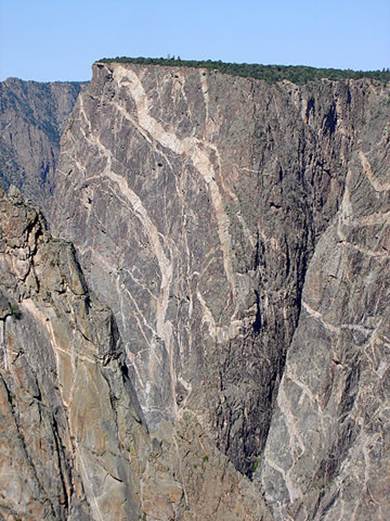
The famous “Painted Wall,” Colorado’s steepest cliff is in the Black Canyon.
[Photo courtesy Wikimedia Commons]